If you sell anything in California, Washington, Colorado or a growing list of other states, the 2026 carryout-bag rules now reach all the way to the spec sheet of the bags you print. The laws no longer just tax a thin plastic sack at the register; they dictate what material a checkout bag can be made from, how much recycled fiber it has to contain, and in some states what has to be printed on the bag itself. For a buyer ordering custom paper bags in bulk, that turns a few lines of legislation into concrete production requirements you have to get right before the plates are cut.
Why paper became the default at checkout
The clearest change took effect on January 1, 2026, when California’s SB 1053 closed the loophole that let stores hand out thicker “reusable” film bags in place of the thin ones banned back in 2014. At grocery stores, pharmacies, convenience stores and most larger retailers, the only bags a cashier may now offer are recycled paper bags or certified compostable bags. Washington reached a similar place through RCW 70A.530, and Colorado, Connecticut, New York, New Jersey and others already restrict single-use plastic at checkout. The practical upshot for most retail and promotional buyers is that a printed paper bag is the compliant, brandable option, which is exactly why demand for spec-correct custom paper bags has climbed.
New Jersey is the important exception to keep in mind, because it bans both plastic and paper carryout bags at stores larger than 2,500 square feet. In that market a paper bag is not a compliance path at all, and a reusable non-woven or woven bag is what you need to be ordering instead.
The recycled-content number your bag has to hit
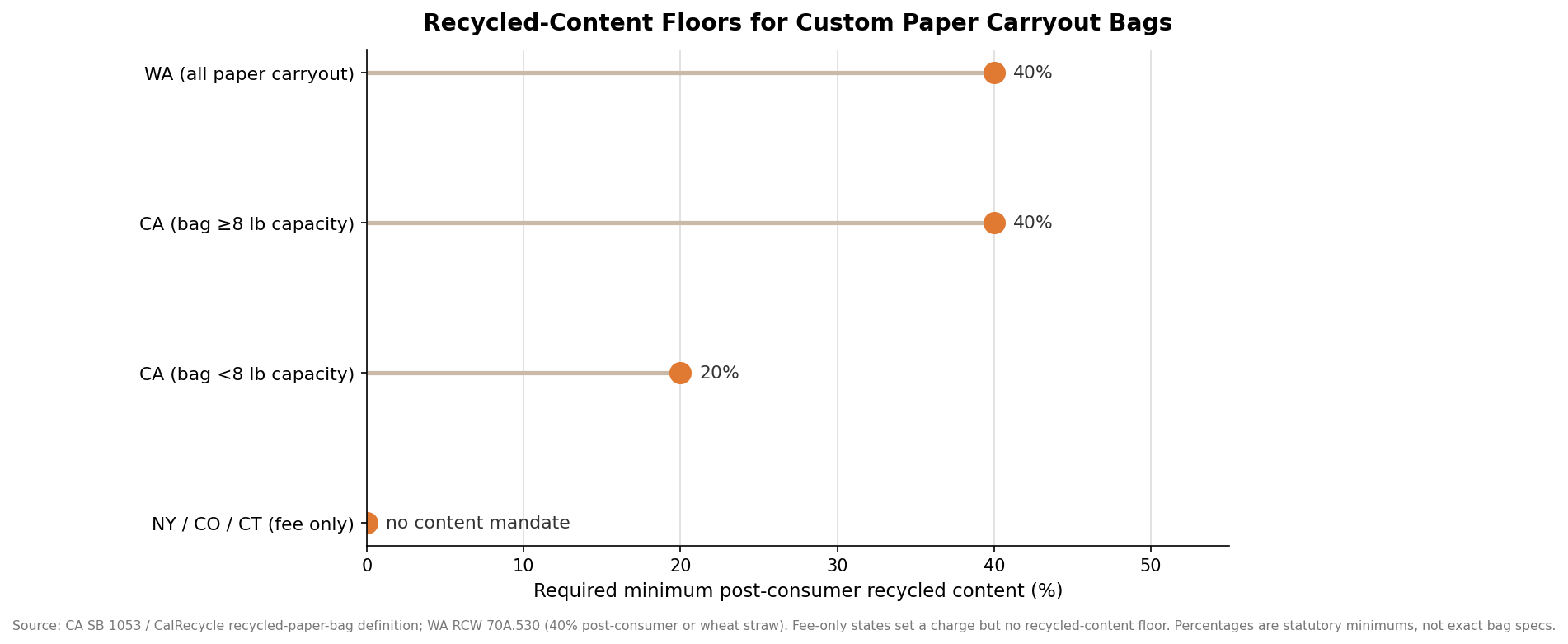
Where states allow paper, most now attach a minimum recycled-fiber floor, and this is the single specification buyers most often miss. California’s recycled-paper-bag definition requires at least 40% post-consumer recycled content for a bag with a capacity of eight pounds or more, and at least 20% for smaller bags. Washington requires at least 40% post-consumer content as well, or fiber made from wheat straw. Fee-only states such as New York, Colorado and Connecticut charge for a bag but do not currently set a recycled-content minimum, so a bag that satisfies California will comfortably clear those markets too.
The takeaway when you buy across several states is to spec to the strictest rule you ship into rather than the average. A stock with certified 40% post-consumer content covers California’s large-format threshold and Washington in one order, and it keeps you compliant even if a customer carries the bag across a state line. Ask your printer to confirm the post-consumer percentage in writing, because “recycled” on a mill spec can quietly mean pre-consumer trim that does not count toward these legal minimums.
What the law makes you print on the bag
This is the requirement that trips up custom orders specifically. California requires each recycled paper bag to display the name of the manufacturer, the country of origin, and the percentage of post-consumer recycled content. That is a printed legend on a product whose whole purpose is your artwork, so it has to be planned into the layout, not bolted on afterward. Leave a clean zone, usually along a lower side panel or the gusset, where that mandated text can sit legibly without fighting your logo. If you hand a printer finished art with no room for the legend, you will either delay the job or end up with a bag that is technically noncompliant in California. A good custom-bag supplier will build the legend into the dieline for you, but you should confirm it is there before you approve the proof.
Bag charges, thickness rules and the reusable exception
Even a compliant paper bag usually cannot be given away for free. California, Colorado, Connecticut, Washington and New York each set a minimum per-bag charge on paper bags at checkout, and Washington also charges for reusable film bags in 2026 while exempting small paper bags under 882 cubic inches and produce bags from the charge entirely. These fees are passed through to the shopper rather than paid by you, but they shape buying behavior, which is why many retailers now order a slightly sturdier bag that a customer is willing to reuse rather than the flimsiest sack that clears the rule.
If you are still considering a thicker plastic “reusable” bag, check the current status carefully. Washington sets a minimum film thickness of 2.25 mil, with a planned increase to 4 mil delayed to 2028; California’s 2026 update removed the thick-film reusable option at the checkout of covered stores; and Oregon’s ban on thicker plastic bags takes effect January 1, 2027. The direction of travel is consistent, so a woven or non-woven reusable bag is the safer long-term buy than a heavier film bag that a later amendment may outlaw.
How to specify a compliant custom bag order
Start by listing every state you will ship or hand the bag out in, then design to the strictest requirement on that list rather than managing several versions. For most multi-state retail programs that means a paper bag with certified 40% or higher post-consumer content, a printed compliance legend built into the dieline, and a construction sturdy enough that a shopper treats it as reusable. Get the post-consumer percentage and the country of origin confirmed on the purchase order, budget for the per-bag charge as a line item your stores will collect, and if New Jersey is in your footprint, plan a reusable bag for those locations from the outset.
One caution: these statutes are amended often, and county or city ordinances can be stricter than the state floor. The figures here reflect the rules as they stand for 2026 and are a starting point for specifying an order, not legal advice for your particular business. Before you lock a large run, confirm the current numbers with the relevant state agency or your own counsel, and ask your printer to certify in writing that the stock and the printed legend meet the markets you named. Getting those details onto the spec sheet up front is far cheaper than reprinting a six-figure bag order that missed a recycled-content line by a few points.