Category: Uncategorized

  • 2026 Retail Bag Laws: Ordering Custom Paper Bags That Stay Legal

    2026 Retail Bag Laws: Ordering Custom Paper Bags That Stay Legal

    If you sell anything in California, Washington, Colorado or a growing list of other states, the 2026 carryout-bag rules now reach all the way to the spec sheet of the bags you print. The laws no longer just tax a thin plastic sack at the register; they dictate what material a checkout bag can be made from, how much recycled fiber it has to contain, and in some states what has to be printed on the bag itself. For a buyer ordering custom paper bags in bulk, that turns a few lines of legislation into concrete production requirements you have to get right before the plates are cut.

    Why paper became the default at checkout

    The clearest change took effect on January 1, 2026, when California’s SB 1053 closed the loophole that let stores hand out thicker “reusable” film bags in place of the thin ones banned back in 2014. At grocery stores, pharmacies, convenience stores and most larger retailers, the only bags a cashier may now offer are recycled paper bags or certified compostable bags. Washington reached a similar place through RCW 70A.530, and Colorado, Connecticut, New York, New Jersey and others already restrict single-use plastic at checkout. The practical upshot for most retail and promotional buyers is that a printed paper bag is the compliant, brandable option, which is exactly why demand for spec-correct custom paper bags has climbed.

    New Jersey is the important exception to keep in mind, because it bans both plastic and paper carryout bags at stores larger than 2,500 square feet. In that market a paper bag is not a compliance path at all, and a reusable non-woven or woven bag is what you need to be ordering instead.

    The recycled-content number your bag has to hit

    Where states allow paper, most now attach a minimum recycled-fiber floor, and this is the single specification buyers most often miss. California’s recycled-paper-bag definition requires at least 40% post-consumer recycled content for a bag with a capacity of eight pounds or more, and at least 20% for smaller bags. Washington requires at least 40% post-consumer content as well, or fiber made from wheat straw. Fee-only states such as New York, Colorado and Connecticut charge for a bag but do not currently set a recycled-content minimum, so a bag that satisfies California will comfortably clear those markets too.

    The takeaway when you buy across several states is to spec to the strictest rule you ship into rather than the average. A stock with certified 40% post-consumer content covers California’s large-format threshold and Washington in one order, and it keeps you compliant even if a customer carries the bag across a state line. Ask your printer to confirm the post-consumer percentage in writing, because “recycled” on a mill spec can quietly mean pre-consumer trim that does not count toward these legal minimums.
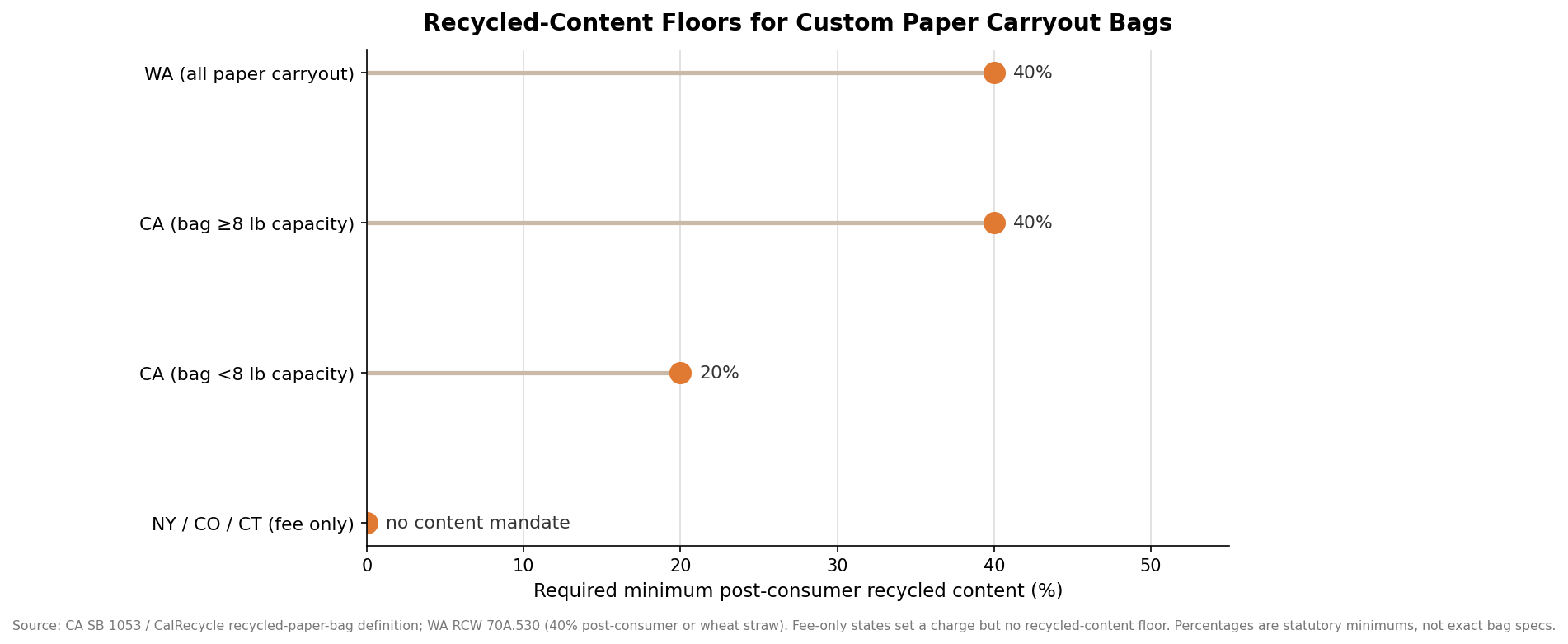
    Lollipop chart of minimum post-consumer recycled content for paper carryout bags: Washington 40 percent, California 40 percent for large bags and 20 percent for small, and no mandate in fee-only states
    Statutory recycled-content floors for paper carryout bags, by state and bag size.

    What the law makes you print on the bag

    This is the requirement that trips up custom orders specifically. California requires each recycled paper bag to display the name of the manufacturer, the country of origin, and the percentage of post-consumer recycled content. That is a printed legend on a product whose whole purpose is your artwork, so it has to be planned into the layout, not bolted on afterward. Leave a clean zone, usually along a lower side panel or the gusset, where that mandated text can sit legibly without fighting your logo. If you hand a printer finished art with no room for the legend, you will either delay the job or end up with a bag that is technically noncompliant in California. A good custom-bag supplier will build the legend into the dieline for you, but you should confirm it is there before you approve the proof.

    Bag charges, thickness rules and the reusable exception

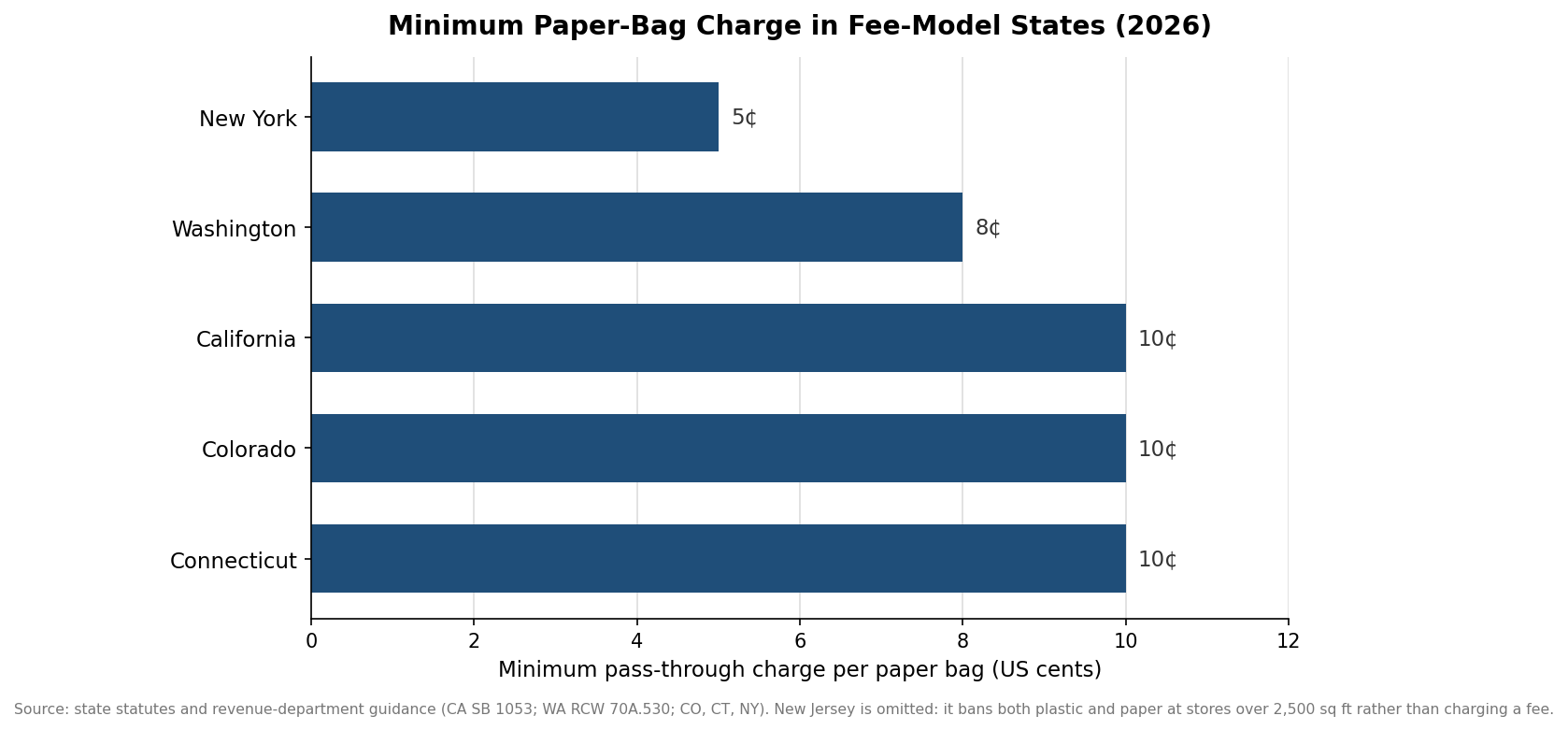
    Even a compliant paper bag usually cannot be given away for free. California, Colorado, Connecticut, Washington and New York each set a minimum per-bag charge on paper bags at checkout, and Washington also charges for reusable film bags in 2026 while exempting small paper bags under 882 cubic inches and produce bags from the charge entirely. These fees are passed through to the shopper rather than paid by you, but they shape buying behavior, which is why many retailers now order a slightly sturdier bag that a customer is willing to reuse rather than the flimsiest sack that clears the rule.

    If you are still considering a thicker plastic “reusable” bag, check the current status carefully. Washington sets a minimum film thickness of 2.25 mil, with a planned increase to 4 mil delayed to 2028; California’s 2026 update removed the thick-film reusable option at the checkout of covered stores; and Oregon’s ban on thicker plastic bags takes effect January 1, 2027. The direction of travel is consistent, so a woven or non-woven reusable bag is the safer long-term buy than a heavier film bag that a later amendment may outlaw.

    How to specify a compliant custom bag order

    Start by listing every state you will ship or hand the bag out in, then design to the strictest requirement on that list rather than managing several versions. For most multi-state retail programs that means a paper bag with certified 40% or higher post-consumer content, a printed compliance legend built into the dieline, and a construction sturdy enough that a shopper treats it as reusable. Get the post-consumer percentage and the country of origin confirmed on the purchase order, budget for the per-bag charge as a line item your stores will collect, and if New Jersey is in your footprint, plan a reusable bag for those locations from the outset.

    One caution: these statutes are amended often, and county or city ordinances can be stricter than the state floor. The figures here reflect the rules as they stand for 2026 and are a starting point for specifying an order, not legal advice for your particular business. Before you lock a large run, confirm the current numbers with the relevant state agency or your own counsel, and ask your printer to certify in writing that the stock and the printed legend meet the markets you named. Getting those details onto the spec sheet up front is far cheaper than reprinting a six-figure bag order that missed a recycled-content line by a few points.
  • How to Spec a Custom Shopping Bag: Size, Paper Weight and Handles

    How to Spec a Custom Shopping Bag: Size, Paper Weight and Handles

    A custom shopping bag order goes wrong in predictable ways: the bag is too shallow for the product, the paper buckles under a normal load, or the handles tear on the second use. Every one of those is a spec decision made before the art was ever approved. Three numbers and one component decide whether the bag works: the finished dimensions, the paper weight, and the handle. Here is how to set each of them deliberately rather than accepting whatever a template defaults to.

    Read the dimensions the right way

    Custom bag sizes are written as width by height by depth, in inches, and the order matters. Width is the face you print on, height is the wall from base to the top opening, and depth, the number buyers most often overlook, is the gusset: the side panel that shows how far the bag expands from front to back. The gusset sets the usable volume and whether a boxed or folded product actually drops in. A bag listed as 8 by 10 by 4 has a four-inch base, which swallows a folded garment easily; the same face at a two-inch gusset would fight you. When you request a custom size, give all three figures and state which dimension is the printable face, because a supplier reading them in a different order will make a bag that fits nothing you sell.

    Match the footprint to the product

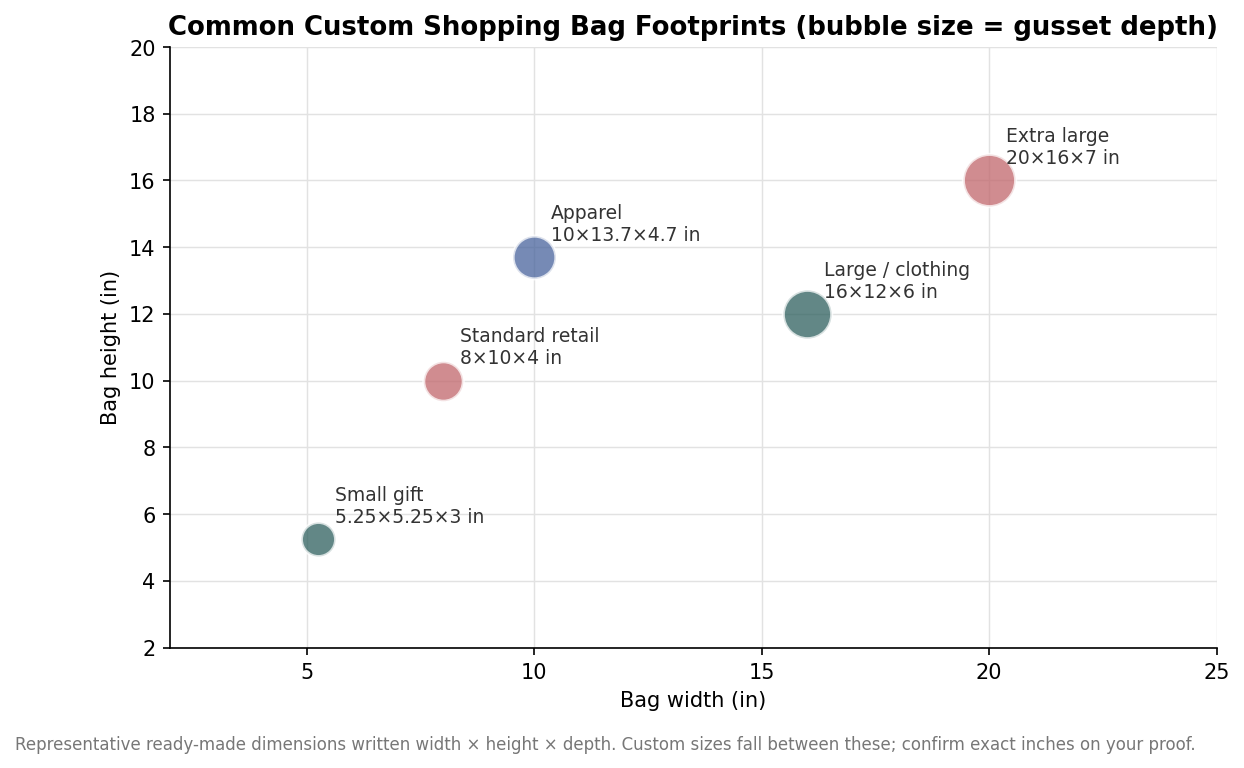
    Start from the largest item that has to fit and work outward, leaving room for tissue and a folded top. Small gift and jewelry footprints cluster around 5 by 5 by 3 inches; standard retail bags for cosmetics, books and compact goods sit near 8 by 10 by 4; apparel bags run taller and deeper, roughly 10 by 14 by 5; and the large clothing and blanket sizes reach 16 by 12 by 6 and beyond. The chart below plots common footprints so you can see how width, height and gusset scale together rather than picking a size off a name alone.

    Scatter chart of common custom shopping bag footprints by width and height with bubble size showing gusset depth
    Representative bag footprints; bubble size shows the gusset (depth) that sets usable volume.

    Naming conventions vary between suppliers, so treat a size name as a starting point and confirm the actual inches. If your product line spans very different shapes, two or three stocked sizes usually cover a catalog better than one compromise bag that fits everything poorly.

    Choose paper weight by what goes inside

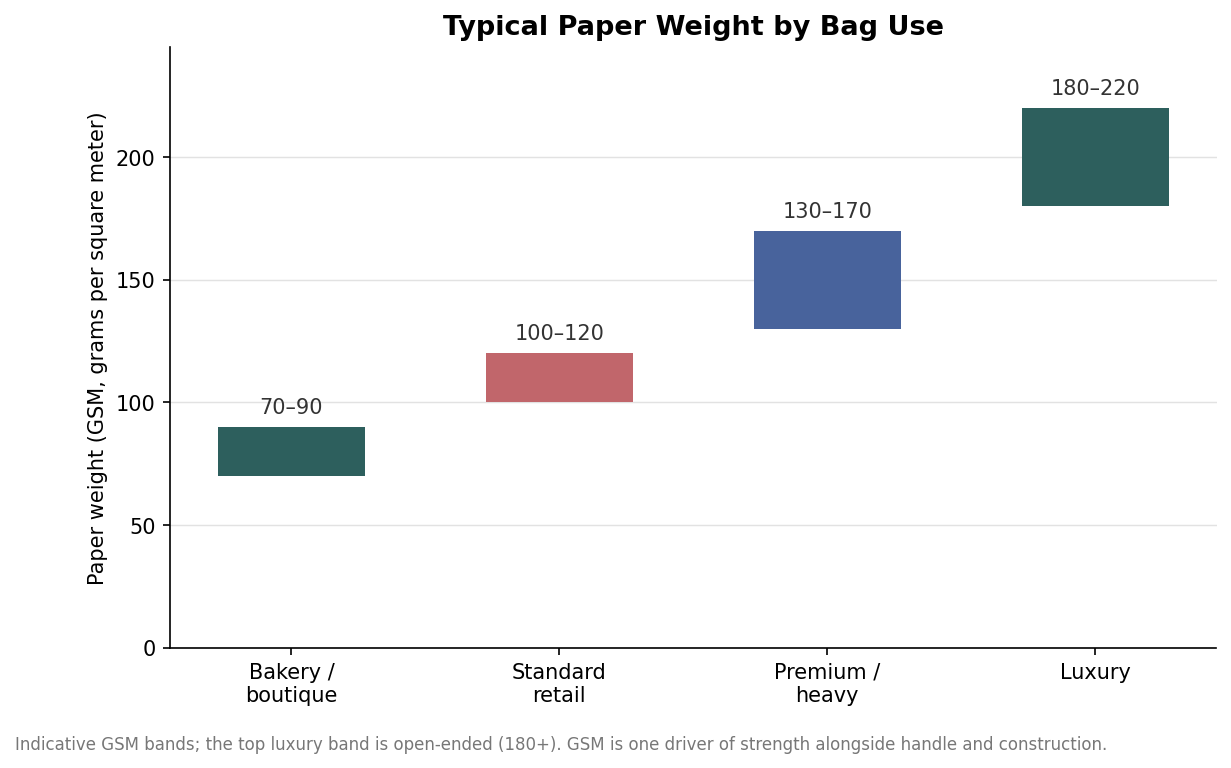
    Paper weight is quoted in GSM, grams per square meter, and it is the single biggest lever on how a bag feels and how much it carries. Lighter bakery and boutique bags run about 70 to 90 GSM, fine for small, light goods. Standard retail bags land at 100 to 120 GSM, the workhorse range for most stores. Heavier and premium bags move to 130 to 170 GSM when the contents have real weight or the brand wants a substantial hand-feel, and luxury packaging climbs to 180 GSM and up. Higher GSM means thicker, stronger paper, but it is not the whole story: a heavy sheet with a weak handle attachment still fails. Match the weight to the actual product rather than defaulting to the thickest, most expensive option, and you keep the bag both reliable and affordable.

    Paper weight travels with two related choices: stock and finish. Natural kraft is the economical, recyclable default and reads as understated or eco-minded, while a white or coated stock gives cleaner, brighter color reproduction for detailed logos. A finish sits on top of that: an uncoated bag is matte and writable, a matte laminate resists scuffing and fingerprints, and a gloss laminate lifts color saturation at the cost of a shinier, less natural look. Lamination also adds a little stiffness and moisture resistance, which can matter for grocery or outdoor-market use. Decide stock and finish alongside GSM, because the three together, not the weight number by itself, are what a shopper feels when they pick the bag up.

    Vertical range bar chart of typical paper weight in GSM by bag use tier
    Indicative GSM bands by use, from light boutique bags to luxury packaging.

    The handle sets the tier and the load

    Twisted paper handles are the budget standard, machine-made and glued in, and they suit light to medium loads for delis, bakeries and gift shops. Die-cut handles, punched straight into the bag wall, cost the least because they add no separate part, but they can dig into the hand under weight and are best for lighter takeout and trade-show use. Rope handles, in cotton or polypropylene, are the strongest and the most premium, which is why jewelers, boutiques and hotels reach for them. Twill or ribbon handles sit in the same upscale tier, stronger than twisted paper and available in a wide range of colors for brands that want the handle itself to read as finished. The handle is also a load decision, not just a look: pair a heavy product with a die-cut hole and you have designed the failure in from the start.

    Put the spec together before you order

    Before you approve anything, write the bag down as a single spec: finished width by height by depth, paper GSM, paper type and finish, handle type, and the print method and colors. Confirm which face carries the logo and how the artwork wraps around the gusset if it does. Ask about the minimum order quantity and the production lead time up front, since custom bags are made to order and both can be longer than stock packaging, particularly for rope handles or specialty finishes that add a step. Where a supplier quotes a load rating or a lead time, treat it as indicative and confirm it against your own heaviest product and your real deadline. A bag specified this way arrives fitting the product, carrying the weight, and looking like the brand, which is the whole point of ordering custom in the first place.

  • Why Your Logo Looks Different on Kraft

    Almost every artwork problem we see starts the same way: a logo approved on a white screen, printed on brown paper, and unrecognizable in the shop. Kraft is not a neutral surface, and designing for it is a genuinely different exercise.

    Brown paper is a color filter

    Natural kraft is a mid-tone warm brown, and every ink printed on it sits over that brown rather than over white. Light colors vanish, cool colors turn muddy, and anything with low contrast against mid-brown simply stops reading at a distance.

    Whites do not print at all in standard flexo — there is no white ink in the process. A logo with white elements will show as bare brown paper wherever the white was.

    What works on natural kraft

    Dark single colors: black, deep navy, forest green, burgundy, dark brown. One color, confidently used, almost always looks better than a full-color attempt.

    Bold shapes and generous type. Fine hairlines and small text lose definition as the ink spreads slightly into the uncoated fiber. Design a size up from what you would use on coated stock.

    What to do about white in your logo

    Three options. Redraw the mark as a single-color version for kraft — which we do free, and which is usually the best-looking answer. Print on white kraft instead, where the reproduction is far closer to screen. Or print a solid ink block and reverse the mark out of it, which works but uses a lot of ink and can look heavy.

    What does not work is hoping the brown reads as white. It does not.

    Ink coverage and cost

    Large solid areas on uncoated kraft need a lot of ink and can show mottling where the fiber absorbs unevenly. That is a characteristic of the material rather than a fault, and heavy coverage usually looks better deliberately distressed than fighting for perfect flatness.

    If you want full flat coverage and photographic detail, that is a laminated litho tote, not a kraft bag. Choosing the right substrate is cheaper than fighting the wrong one.

    Always proof on the actual stock

    A screen proof tells you nothing about how a color sits on brown paper. Ask for the mockup rendered on the real substrate, and for a physical sample before a large run if the color is critical to the brand.

    We render the mockup on the actual stock as standard, and it is the step where most customers change their mind about color — almost always toward something simpler and darker.

    What to send us

    Vector artwork if you have it, and your PMS references. If the logo is white or light, say so and we will send back a single-color kraft version free alongside the mockup so you can compare them properly.

  • Paper, Non-Woven or Cotton? Choosing by Trip Count

    The paper-versus-reusable argument is usually had in slogans. It is actually an arithmetic problem, and the answer depends entirely on how many times the bag gets used.

    Paper: low impact per bag, low trip count

    A kraft bag is cheap to make, recycles in ordinary streams, and breaks down if it escapes. What it does not do is survive many trips — a handful at best, and one if it rains.

    That makes paper the right answer for purchases people carry home once, which is most retail. Handing a customer a heavyweight reusable for a single greetings card is not the greener choice, whatever it looks like.

    Non-woven: the middle option, and the weight trap

    Non-woven polypropylene is inexpensive, folds flat and carries far more than paper. At 100 to 120gsm it genuinely survives dozens of trips, which is where its footprint pays back.

    At 70 to 80gsm it does not. It stretches out of shape on the second heavy load and ends up binned, at which point you have distributed a plastic item for one use. If you are buying non-woven, buy the weight that gets reused or do not buy it at all.

    Cotton: the highest cost per bag, the highest ceiling

    A cotton tote has a substantial footprint to produce — it needs a lot of trips before it beats paper on any measure. But it is the only bag on this list that becomes a personal object, and people carry good ones for years.

    The determining factor is weight and finish. An 8 oz giveaway tote gets used a few times; a 10 to 12 oz canvas with cross-stitched webbing and a decent print gets carried to work. Spend the money there or choose a different material.

    Match the material to the purchase

    Single low-value purchase, carried home once: kraft paper. Weekly grocery shop: non-woven at 100gsm or above. Premium purchase the customer wants to be seen carrying: laminated euro tote. Merchandise or a brand people opt into: cotton canvas.

    Most shops need two of these, not one, and the split is usually a cheap everyday carrier plus one good bag for larger purchases.

    The claim you can actually make

    If you want to say something on the bag, say the specific true thing. ‘FSC recycled kraft’, ‘made with 80% post-consumer waste’, ‘certified compostable’ with the standard printed. Those survive a customer question and a regulator.

    ‘Eco friendly’ and ‘biodegradable’ do not, and increasingly people know it. A vague claim on a bag is worse than no claim, because it invites the question.

    What we would recommend

    For most independent retail: 150gsm natural kraft with a reinforced turnover as the everyday bag, plus a matte laminated euro tote for larger purchases. For grocery: 100gsm gusseted non-woven. For merchandise: 10 oz cotton, printed once, sold not given.

  • The Complete Buyer’s Guide to Custom Shopping Bags

    Buying shopping bags looks like choosing a size and a color. It is really four construction decisions, and getting any of them wrong produces the same result: a bag that fails in public while carrying your name.

    This guide covers those four, then the print and sustainability decisions that follow.

    Paper weight, and what it actually carries

    100gsm kraft is a light carrier for clothing and gifts. 150gsm is the retail standard and handles about 10 pounds with proper construction. Above that you are into heavyweight stock for bottles, tins and deli loads.

    The weight only delivers if the construction is there. A 200gsm bag with no turnover will tear at the handle before a 150gsm bag with one. Paper weight alone is not a strength claim, though it is often sold as one.

    The turnover is the whole handle story

    The turnover is a folded band of paper glued inside the mouth of the bag. It spreads the load from the handle across the bag’s top edge instead of concentrating it at two glue points.

    It is invisible in a photograph, it costs a fraction of a cent, and it is the single most common thing missing from cheap bags. If a quote seems unusually low, this is where to look first.

    Base inserts and why bags sag

    A card panel in the bottom is what lets a bag stand open on a counter and be packed properly. Without one the base bows, the contents tip, and the bag becomes a sack.

    For anything a customer packs at a till, or anything with weight in it, treat the base insert as mandatory rather than optional. It is standard on everything we make.

    Handles: twisted, ribbon, rope or webbing

    Twisted paper is the everyday retail handle — cheap, recyclable with the bag, strong enough with a turnover. Grosgrain ribbon reads premium and suits laminated totes. Cotton or braided rope belongs on rigid bags and must be knotted inside and capped, never glued to the face. Cotton webbing on canvas totes should be cross-stitched at both ends.

    Handle failure is almost never the handle. It is how the handle is attached.

    Print: spot color, litho or heat transfer

    One or two spot colors on kraft is the most cost-effective print there is, and on natural brown a single dark color usually looks better than a full-color attempt. Litho on art paper reproduces photography and gradients properly and is what laminated totes use. Heat transfer handles full color on non-woven.

    Ask to see the artwork on the actual stock. Natural kraft absorbs ink and shifts color; a logo that reads perfectly on screen can disappear on brown paper.

    Sustainability claims that survive scrutiny

    Recyclable, recycled, FSC, compostable and biodegradable are not synonyms and only some of them are regulated. Compostable is a certified standard; biodegradable is an unregulated word.

    Print the certification you actually hold, not a mood. We will tell you which marks your chosen stock qualifies for and decline to print the ones it does not, because an unsupportable claim is a real risk for the person whose name is on the bag.

    What to send us

    The bag style, your finished dimensions or the items going in it, roughly how many, and whatever artwork exists — a photo of your shop sign is enough. Tell us if bottles or tins are involved and we will specify up rather than let you find the limit at the till.